

AI collides with the Eisteddfod; human casualties ensue
How do you police the unpoliceable?

[Os ydych chi’n siarad Cymraeg, mae fersiwn Gymraeg o’r erthygl yma ar gael]
I haven’t been a regular visitor to the Eisteddfod in recent years. Life has been a hurdle — climbing trips during sunny months, freelance work, or simply the fact that I moved out of the majority Welsh speaking community that I was born into. Whatever the reasons for my absence, I was excited to attend once more this year. The fact that it was my partner’s first Eisteddfod and a chance for her to flex her growing Welsh proficiency in this, the most challenging and rewarding of linguistic environments, added to my anticipation.
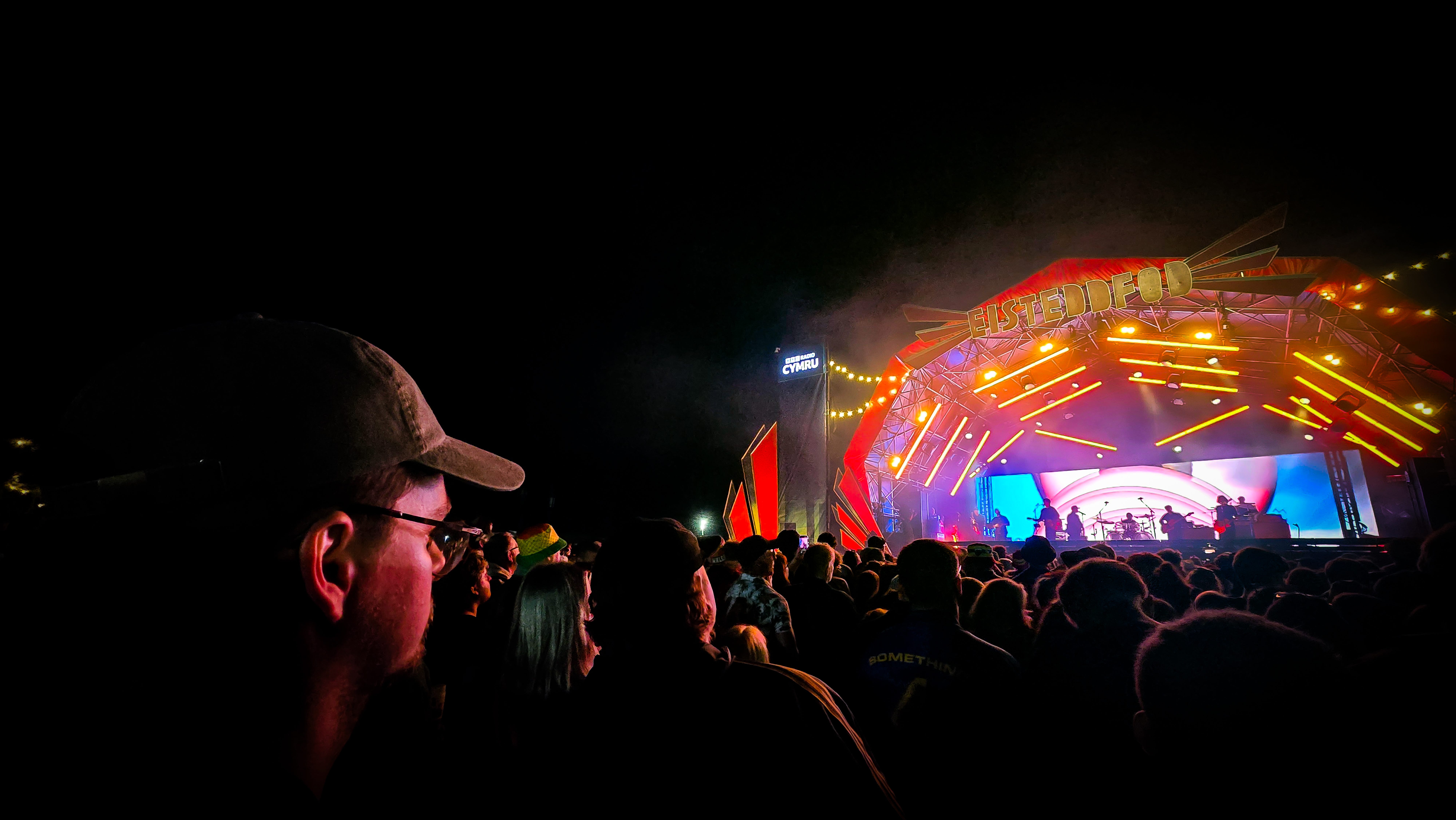
The Eisteddfod, in many ways, is much the same as I remember it. You can’t get ten paces without bumping into the parents of a childhood friend, an old flame, a bandmate, a teacher or a famous singer. The beer is expensive and there aren’t enough water taps or toilets.
AI Slopwatch
But like the rest of the world — the Eisteddfod has changed somewhat. A harbinger of what was to come, I began to spot signs and billboards made with AI art dotted around the field (y maes) of the festival. Of those I saw, two were the advertising boards of businesses that held stalls, and another belonged to the (possibly official?) Eisteddfod café — Lolfa Goffi.
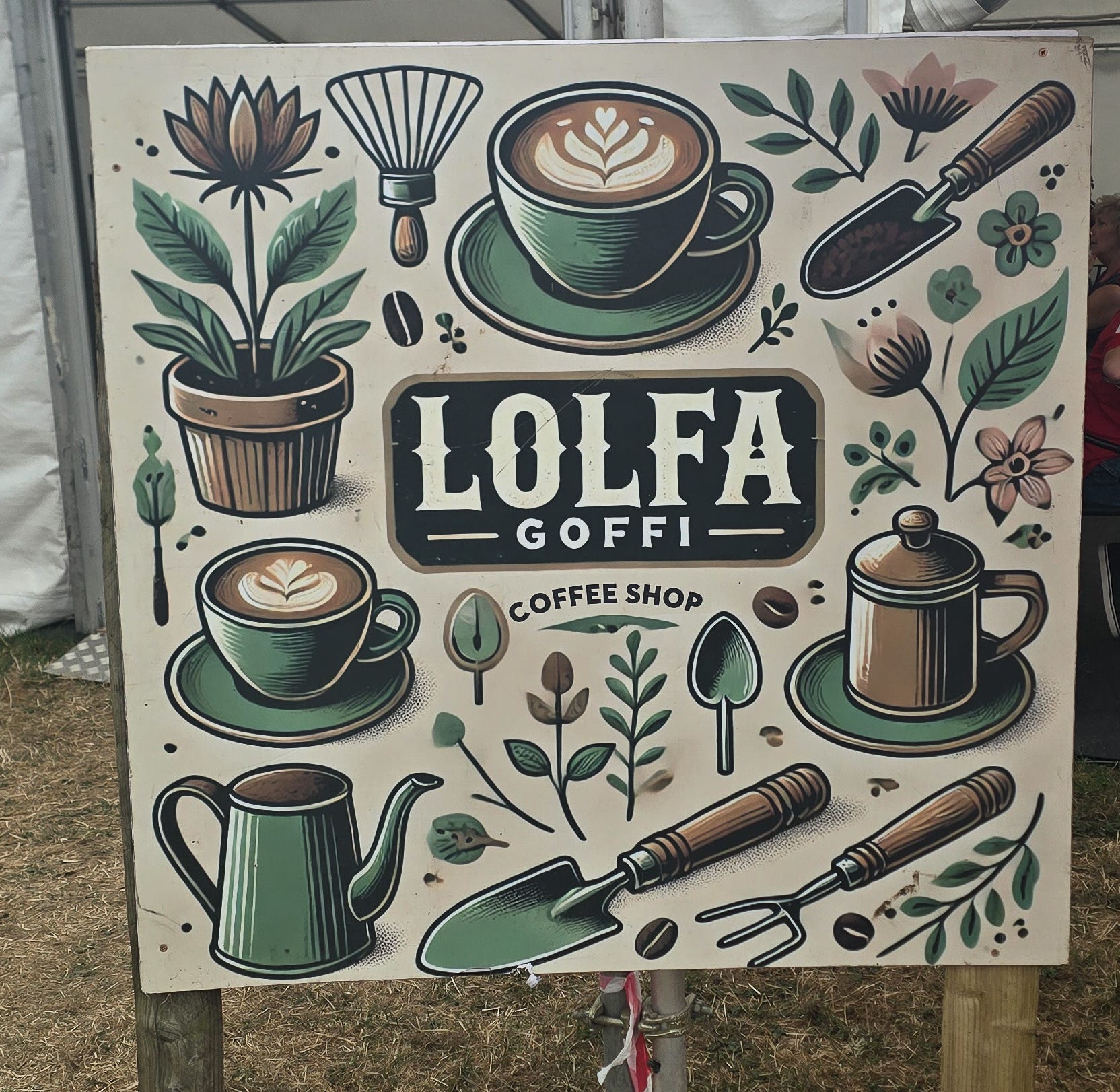
I didn’t like it. In fact, I hated seeing it — I thought it looked nasty and bad and it felt like an encroachment. It’s not the Mona Lisa but my taste isn’t really the issue here. Two of them were meant for children to stick their heads through and pose for a photo — I’m sure many have. In a different world (of five years ago) where someone would have had to do a (possibly naff) job of it on a shoestring, I don’t think either me or the business would be worse off, and yet here we are. At a different festival — a Green Man, a Glasto, or a Fire in the Mountain — would punters accept this kind of thing as the setting for their fun? There’s no way in hell.
So I started dubbing it ‘Slopwatch Eisteddfod’ and posting through my irritation on social media, prompting a conversation with a journalist who apparently quizzed the Eisteddfod CEO about their official AI policy (there is none). I disliked these installations for the same reason I would dislike seeing English-only signage or performers at the Eisteddfod. I didn’t blame the businesses, who have chosen (at great cost) to support the festival. I even bought a book from one of them! But I thought the decision should be taken out of their hands — that there should be a rule explicitly declaring that it is unwelcome anywhere in the Eisteddfod, much as the ‘rheol iaith’ limits the use of English there.
Rheol iaith - language rule
For the uninitiated, the ‘rheol iaith’ at the Eisteddfod is an oft-debated rule which safeguards the festival as a (unique) Welsh language space where fluent speakers, learners, and astonished newcomers can be truly immersed and surrounded by Welsh. This, unfortunately, comes at the cost of exclusion for artists whose works are inextricably bilingual — such as rapper Sage Todz, or historically speaking, the Super Furry Animals (who I am told once played a set wordlessly, and got the audience to simply sing their parts for them). Over the years it has also excluded English-speaking Welsh intellectuals such as Professor Laura McAllister, who was once heckled.
First and foremost, the Eisteddfod is a linguistic space — a Welsh language one. But secondary to that, and not a particularly far second, it is an artistic and creative space. A space by, and for humans. Not only the ‘Pabell Len’ (literature tent), or the ‘Lle Celf’ (art place), nor on the many stages. The whole Eisteddfod. Such a policy wouldn’t put the festival in the luddite category, but rather in line with modern policies such as the new EU directive that requires labelling of AI content.
A fly in the ointment
But then, something occurred that made me question myself and my demands for rules and regulations. At first I felt affirmed in my righteousness when the judges of the prestigious Gwobr Goffa Daniel Owen (the prize given for the best novel) broke into a tirade against one of those who sent in their work — accusing them of authoring it with the assistance of AI:
“There is no plan or story arc in this novel. And the garbled and erroneous expression makes the whole thing almost impossible to read.
So much so that we suspect that an artificial intelligence machine has created the novel and that the author hasn’t bothered to read over the work either.
According to Llwyd Owen, the only consolation is this - if this is the best our future overlords have to offer, the future of Welsh literature is secure.
It was ‘shameful’, they said, to send such a novel to a competition as prestigious as this. When I read those words I felt vindication, as if I was — through my whinging — some kind of prophet of Eisteddfotic doom; ‘if we allow the AI billboards, then we will end up with robot novelists and computer poets’.
But then a fly flew into the ointment. This was no AI novel; it was written by someone who only very recently learned the language. Someone I happen to know.
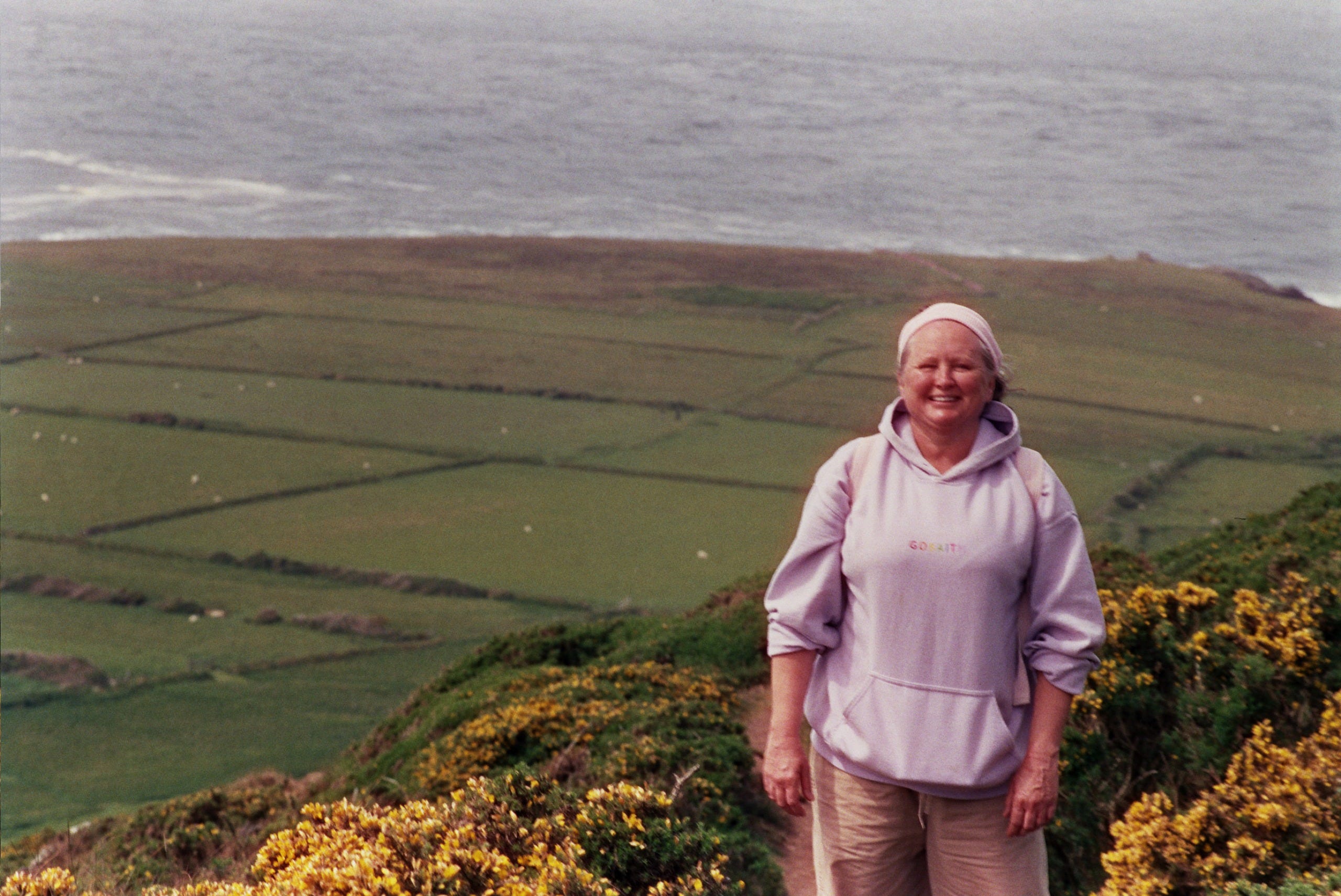
Romy Wood is a writer who has chosen to reinvent herself and her writing practice — a creative writing tutor and drama teacher, and a published author in the English language, by the same publisher as one of the judges. I met her on a writing residential on Ynys Enlli — as part of a mixed group of Welsh and English speakers with a varied degree of proficiency in both languages (as well as one German speaker). Romy was one of several on the course who had recently (and furiously) been learning Welsh, reclaiming a language she rightly feels is hers. While I — a first language Welsh speaker who has mostly published in English — began the week as I had been before; coy about writing in my mother tongue, taking the easy option of swimming in the shallow and safe waters of English — the language that is professionally and personally ubiquitous in my life as an adult. In short, I began to take the easy option.
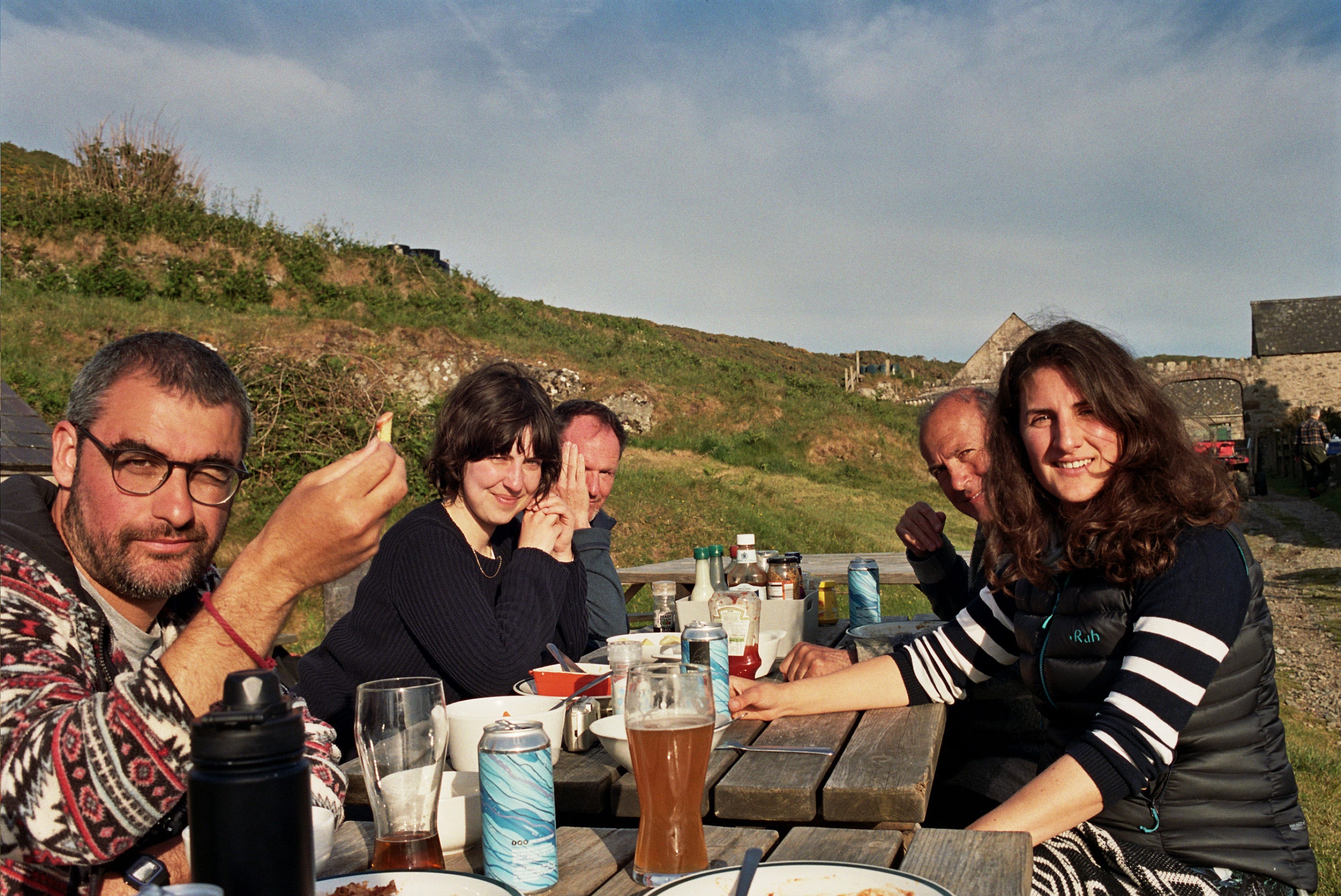
I was thus, challenged, when Romy never wrote and rarely spoke a word in her own mother tongue. All week she laboured and scribbled away at her notepad (no internet, no electricity, and certainly no AI), writing stories and poems in a tongue she had no words of just a few years before. I found myself bewildered and a little shamed into experimenting myself — writing poems in Welsh for the first time since I was a child (or maybe ever?!), feeling the tiny buds of a writer’s voice, all of my own, in a language I had creatively lost touch with, begin to germinate. I owe that to Romy, Mike, and Ciara, and Yusuf from Enlli that week.
In Wales we often speak of Welsh learners as if they are recruits — another foot soldier for the army of one million that we must muster before 2050. But they are more than that. In spaces like that writing residency, they have the ability to shine a light on people like me in a way that is often desperately needed and sometimes uncomfortable. They see the language in a way that some of us easily forget — as exciting, challenging, precious, and aspirational. They expose us as lazy and willing to let others do the hard work of keeping the language alive on our behalf.
All week, Romy shared her voice with us — her struggles with creating overarching narrative structures (a struggle I share), her desire to create experimental fiction and simply embrace the story she felt bursting out of her instead of being shackled to convention. It was undoubtedly this experimental, idiosyncratic voice which drew the ire, and ultimately the dehumanisation of the Gwobr Daniel Owen Judges. They called Romy a robot. It was deeply wrong to do so.
There is no way in hell that Romy used artificial intelligence to write her novel. It isn’t acceptable that a fear of AI means that when someone like Romy chooses to send her work for evaluation, it is dismissed and disparaged as the work of a machine.
When I went to watch the full video of the judges snickering about their verdict, feeling that they had foiled the great AI overlords, I felt angry at myself, and ashamed. The alleged imperfections, the strangeness of Romy’s writing surely prove her humanity. It is the smoothness of a large language model which defines it as inhuman — an AI which has robbed its frictionless diction from thousands of artists, living and dead is incapable of truly holding perspective, especially odd or flawed ones. And as Romy has since asked — who does it serve to give more attention to the qualities of those who didn’t win the prize than the person who ultimately won — Rebecca Thomas, who also happens to have written her novel on Enlli. It’s a shameful episode — one that lends credence to horrible Huw Edwards’ accusations of elitism and self-righteousness.
Anger makes you do stupid, cruel, reckless things
To give the judges their due — paranoia about the use of AI in the arts can be all-consuming, and as I know from my ‘slopwatch’, it can drive you to anger. Anger makes you do stupid, cruel, reckless things. It shouldn’t fall to Eisteddfod judges to take on a crusade against AI submissions of poetry or prose, real or imagined. But it’s clear they feel that it is, and through their blunder I fear that the fight for a fully-human Eisteddfod has taken a heavy blow.
The CEO of the Eisteddfod, this week, said that they relied on trust in their competitors to ensure they abide by the process and produce their own work. I admire the optimism but I feel that it’s a dereliction from our national cultural festival.
I do think that we’re a long way away from an Large Language Model coming victorious in a major Eisteddfod competition. But I also know that languages are getting more sophisticated, and their use is becoming more subtle and widespread (‘hey Gemini, give me a narrative structure for a story involving X, Y, Z’). It will soon be impossible to truly police if it isn’t already. And we’ve seen what happens when you try.
So what, then? My feeling is that we must quickly and clearly draw our lines in the sand when it comes to AI in art and creative practice — that there should be none of it. That may be difficult or impossible to police. But shaping culture is still possible. Impossibility of policing could easily be said of the ‘rheol iaith’ today — God knows there are plenty of ways in which the English language finds its way to having a big presence on the field of the Eisteddfod. Many publishers are grappling with the same thing at the moment, in all languages. But when I, as a writer, am greeted with a firm statement and real boundaries that say that AI-produced creative work is always unacceptable, at least I know where they stand. And I want to stand with them.
We need to make it clear what’s most important in the Eisteddfod (and beyond). Not perfection, or even quality, but humanity.
Thanks for this honest appraisal. I feel a visceral loathing of AI, not just for the characterless pap it extrudes but because of its cumulative dumb-down effect on the audience.
Older people have had a lifetime’s exposure to high quality creative work, and recognise that it is only produced by a lot of effort and growing discernment.
The contemporary marketing of ever-increasing “frictionlessness” means that the easy option is made to look more appealing, whereas - as any creative knows - the struggle with the medium is what the whole process is really about.