
How to create 'cool'.
The ordained enemies of the countryside, and some unintended consequences

Working in access, I’ve seen a lot of rubbish. I’ve seen gullies bursting with windblown litter, I’ve roadsides full of spent BBQs, and I’ve seen bundles of bale twine and plastic rap caught on miles of barbed wire. I’ve also seen more than my fair share of hysterical news headlines blaming the mountaingoing public for just abvout every sort of social malaise you can imagine; whether it’s disturbed nests, overtourism, erosion, traffic, mountain rescue time wasted, or anything else, there is always a North Wales Live article screaming from the rooftops about it, and how our mountains are full of the worst of humanity. It’s enough to drive a person mad, and there is plenty of said madness in any given comments section — calls for all sorts of medieval punishments for these troublemakers.
The loudest screeches, however, are usually reserved for the cardinal sin; wild camping. The stream of fever-pitch accusations that this activity — which is part of a recreational tradition going back centuries — draws is deeply silly. There’s a universal conflation of antisocial activity (where damage or disturbance takes place) with legitimate recreation that was established as such by the highest court in the land only last year.
I can understand councillors, National Park Authorities, and even well-meaning newspaper editors and copywriters (let’s be charitable) who hold a desire to reduce the amount of problem camping (increasingly known as fly camping, or dirty camping) taking place in their patch. I’ve seen councillors across the UK decide to take this on as a sort of cause célèbre — for what is more useful to a cynical politician than something to be against?!
Take this week’s farcical offering;
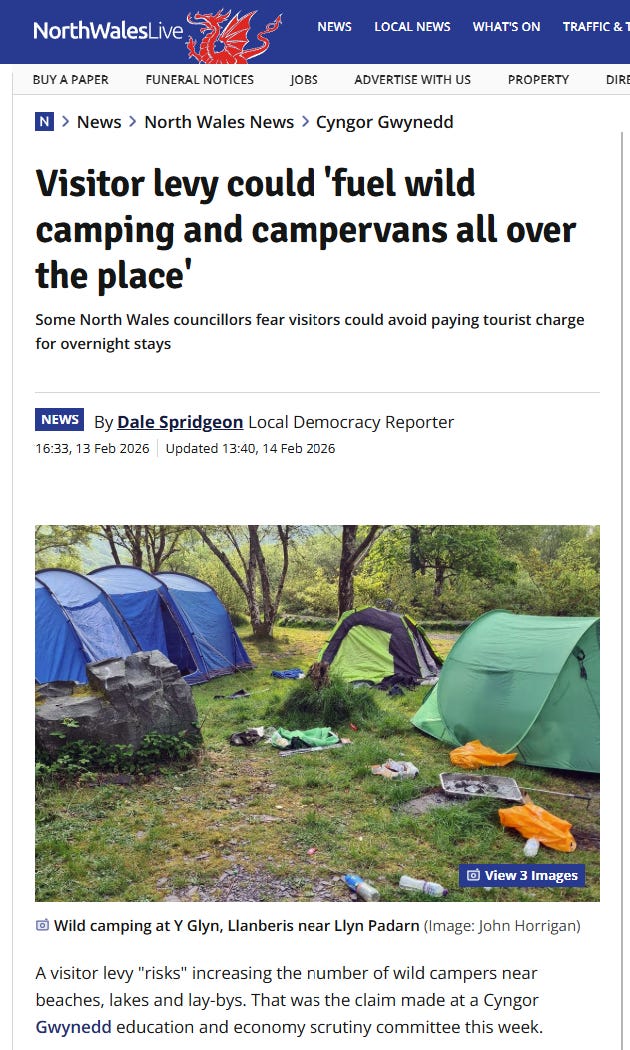
The premise of this article (one of about seven which are each cookie-cutters of a press release) is apparently that the (possibly) incoming visitor levy is going to cause a flood of wild campers that will overwhelm the countryside. A wild stampede of canvas-dwellers crawling over our hills. Got it.
For context, as part of my day job I’ve engaged with all aspects of consultation for the levy, from open, face-to-face consultation discussions, to giving evidence to the scrutiny committee, to collecting responses for the main consultation survey. Through this, I saw a lot of things. For instance, I witnessed several representatives of big caravan holiday parks froth, seethe, and yell aggressively at consultation facilitators and angrily berating any participant who dared suggest the levy could yield some positive results if funds were used for to improve visitor experiences and services. I was also part of the successful lobby effort to reduce the cost of accommodation for specific cases (typically low cost shared-facility accommodation and camping), and to have young people made exempt from that kind of accommodation entirely. Due to this, the financial impact of the levy on families seeking to go camping is relatively small, particularly when compared the overall cost of a modern campsite which is often in the region of £16-25 per night, per head, unfortunately.
I’ve also been part of a team that’s conducted a survey (the largest of its type that I’m aware of) aiming to properly understand the motivations, experiences, and activities of those who go wild camping, so that the social case for (or against) it can be understood, and problem elements can be managed. We have hundreds of survey participants, who’ve opened up their hearts and spoken of the remarkable experiences they’ve had on camping trips in the hills. The confrontations and the weather they’ve weathered, the sunrises they’ve enjoyed, the birds, the foxes, the badgers, the human beings they had as company; they’re all in there. It has never been more clear to me that wild camping, which has and always should be free, is an activity completely defined by its own merits, which people seek out not as a cheap alternative to a conventional campsite with a block shower and a ping pong table, but because they want to go wild camping. For some who have never ventured to try it, money seems to be the only conceivable motivating factor for braving Welsh mountain weather at night time, but trust me, it’s true.
So what those who created this story hope to achieve with such horseshit? It’s pretty obvious to me; the very profitable commercial tourism industry doesn’t like the levy, is quite afraid of it and wants to lobby public opinion against it. At the same time, these businesses don’t feel they can earnestly speak or brief against it without attracting the negative reaction such a thing would deserve. Won’t someone think of the holiday let landowners?!
Hence, an ordained enemy, a bogeyman is needed. That’s what wild camping has become: a convenient patsy. Conflate the good with the bad, tar with a broad brush, and voilà ; you have a scapegoat roaming the hills! A donkey on which to pin the problems of the countryside. And to stop them, we must avoid this tourism levy! When you spell it out like that it’s a deeply stupid premise, and unbeknownst to those dishing it out, all this scolding, the blame, the hysterics are pushing popular culture in a direction I don’t think they’re going to like.
Reactance theory: how not to get a job done
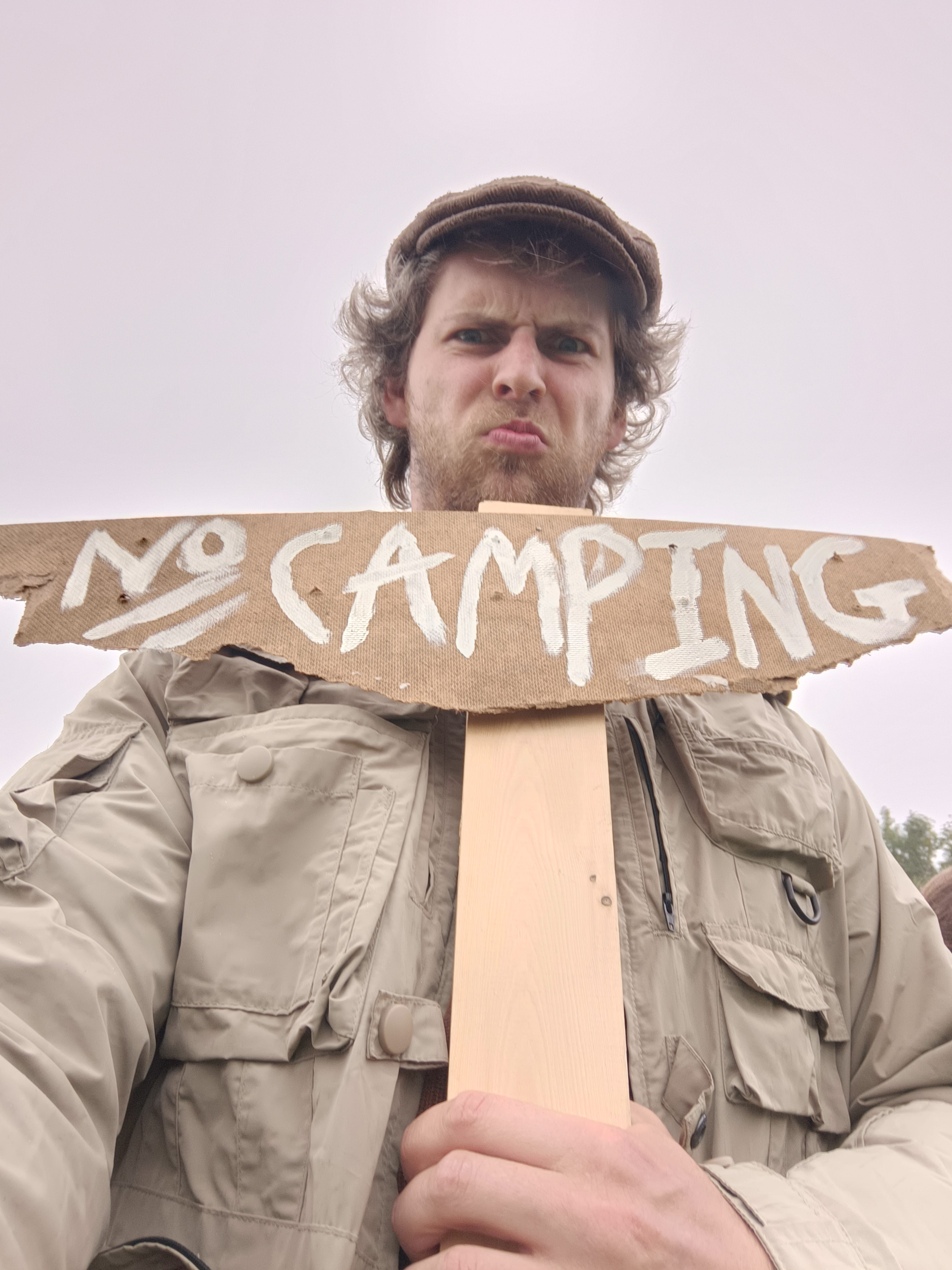
At an access forum last month I heard a National Park staff member say they couldn’t put ‘no camping’ signs up any longer because people keep stealing them. I’m certain those signs now adorn the walls of people who probably started off wild camping as a way of connecting with nature, but who’s now motivated by something stronger; a sense of mischievous injustice.
Reactance theory is a well-established notion in psychology that says that when individuals perceive that their freedoms are being restricted, they experience a motivational state aimed at reclaiming that freedom. Think of a big red ‘do not touch’ button, or a sign that warns ‘do not walk on the grass’. How do those make you feel? Any parent or teacher will know exactly what I’m talking about; there’s no more effective way of compelling the public and their tents to hit the hills than to engage in these absurd exaggerations all the time. An obvious case study of this cause and effect in action is the explosion of wild camping that’s occurred on Dartmoor where the comically villainous Darwalls took practically the whole country to court to strip their right to camp away from them. Among the many spurious grounds for doing so was the accusation of wildfire risk, which was promptly shown to be total baloney.
A sign that this process of cultural blowback is underway across the UK is the birth of a popular new genre of heavily ironic memes taking swings at a perceived authoritarianism inherent in the way wild camping is policed and in the way they are confronted.
It’s so easy to portray the treatment that wild campers get as ridiculous and needlessly punitive, because it is. This meme went instantly viral and has more than 30k likes.
‘Cool’ is unicorn dust. Something that every marketing professional strives (and often fails) to summon, every business wants to buy. But it seems that thanks to the pig-headed obstinacy of our click-frenzied media, an opportunistic breed of local politician, plus a compulsion to caricature an enemy against which any rural issue can be cleanly defined, wild camping is becoming very cool indeed.
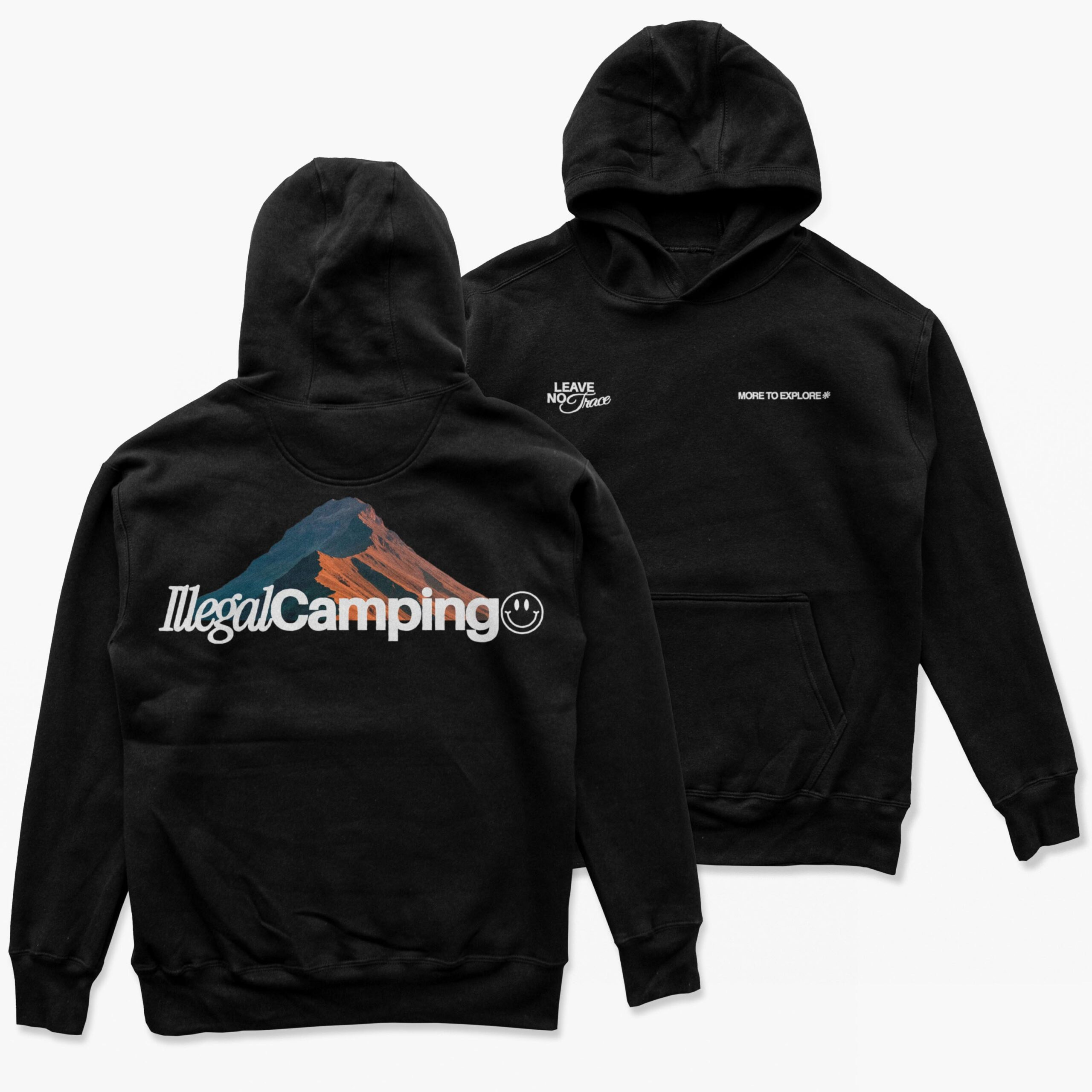
Another big hit here, earning 36k likes, is taking the piss of a copper on his way on a quad bike to arrest some youths for ‘sleeping on a hill’. It’s good! Notably it’s now good business decision to flick V’s at anti wild camping bores and disciplinarians; it doesn’t really matter that wild camping is technically unlawful, not illegal, you can now get a ‘leave no trace/Illegal Camping’ hoody for a cool £54.
What we all know in our hearts is that sleeping on a hill isn’t really worthy of punishment. Outdoor educators shouldn’t have to pay off farmers or risk shouting matches on the moor. A quiet bivvy in a hidden cwm isn’t the same as a group of lads having a fire next to the road, but neither are worthy of being dragged across local news and broadsheet papers on a rotating cycle as they are. Even if you do it ‘wrong’, it’s not worth a public shaming. In fact, we owe it to those who are doing it ‘wrong’ to define what ‘right’ is. Where is the vision of our ideal wild camper? It is conspicuously absent from the Countryside Code — a resource most of our National Parks currently signpost the public to. Other National Parks simply lie, stating that wild camping is a criminal offense. Our institutions are not upholding their side of the bargain, and to expect things to simply improve through prohibition that can never be enforced is hopelessly naive.
No bones about it; this current state of affairs is a farce, and as long as it remains so concerned parties will keep achieving the exact opposite of what they intend to. More will join the masses on the canvas-dotted hillsides, more will wish to nick or vandalise prohibitive signage, more will join their voices for the call for wild camping to treated as what it is: a valid form of outdoor recreation like any other. One that should always be done responsibly, with regard for others.
(As ever, all views expressed in this substack are my own, not those of my employer!)
I support the right to roam responsibly including wild camping. A barrier to exploration of the outdoors is the current perception in England and Wales of it not being ‘allowed’.
I also support those making a living from the land who have to deal with those who, usually through ignorance not malice, make their life more difficult.
There needs to be a cultural shift so that we Brits behave more like others in northern Europe. Part of that shift will come with familiarity but some will have to come through education. How many know about Neosporosis or the impact dogs may have on ground nesting birds or pregnant sheep?
Superb and I'm completely in agreement with this.